
In his 1923 book The Art Spirit, American artist and teacher Robert Henri observed that “Art is the expression of the life of a people.” Henri’s principle, expressing the significance of art, remains integral to understanding American nationhood and its global impact. As the United States approaches its 250th birthday and the public celebrates great American contributions to the world, many forget American art. From fashion to theater, painting, music, dance, and beyond, American art must be recognized for shaping national identity, for revolutionizing culture, and for echoing new movements both domestically and across the globe.
One of the earliest demonstrations of American art reflecting broader social ideals emerges in the birth of American autonomy vis-à-vis colonial art. Reflecting its society, 16th and 17th-century colonial art was characterized by European artistic styles—most notably, the dramatic grandeur of the Baroque, which flashed European wealth and authority. Given that colonial artists brought the framework of European culture with them to the New World, their work exposes how, initially, American identity at large was limited to British subordination. The dependency on British cultural norms formed colonial America’s stylistic choices. Their European-styled art was the physical result of a politically, legally, and culturally derivative people. For instance, John Smibert’s 1729 portrait of Francis Brinley (now on display at The Metropolitan Museum of Art), portrays Brinley sporting typical London fashion, and sitting in a European aristocrat’s pose. Yet Brinley was a colonial American official in his own right, something that cannot be discerned as he merely mimics English noblemen in this artwork.
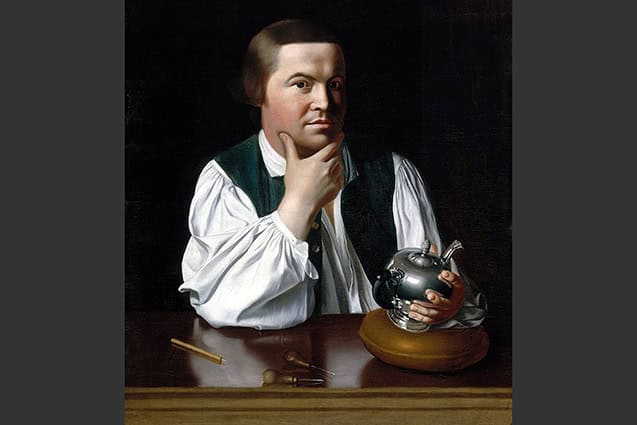
The decades leading up to the American Revolution marked a turning point that produced a new generation of colonial artists who forged a distinct style: one marked by balanced dignity, simplicity, Neoclassicism, and realism. Artists such as John Singleton Copely, known for his portraits of figures like Paul Revere, rejected European excess and aristocratic ideals, embracing a culture of stark contrast. Their art elevated honest and humble American professions and glorified practicality. In doing so, the artists concretized a new sense of American pride, autonomy, and civic virtue. These painting choices contributed to the creation of new and enduring American symbols that evoke national unity and pride to this day, including the bald eagle and the American flag.
Thus, art operated in two ways simultaneously: as political propaganda and as a cornerstone of an emerging and distinct American identity. In fact, according to American historian David McCullough, “The Revolution was as much about ideas as it was about action.” That is, the new American morale and culture, inspired by ideas made tangible and popular through the arts, defeated the British philosophically. Patriotic paintings, literature, and theater empowered colonial soldiers and the war effort, reminding them of what they were fighting for and inspiring them to victory.
However, Henri’s claim that “art is the expression of the life of a people” rings true in moments of triumph as well as in hardship. For instance, in the ‘Roaring Twenties,’ American art, taking the form of materialism in fashion, Jazz music, and dance, lulled the nation and world into a false sense of economic security. The art gave the impression that America’s period of prosperity could last forever, only to be devastated by the 1929 stock market crash and Great Depression.
Today, art is nationally accessible like never before in terms of available materials, education, and public galleries and museums. In cities, murals coat every corner, graffiti is ubiquitous, people dance in endless TikToks, and buskers serenade the public. In a generation of polarized social and political divides, art can be the common ground for people who otherwise clash. Individuals who disagree on social and political dilemmas can still attend the same concerts, adore the same street art, obsess over the same book series, and enjoy the same Broadway shows. The accessibility of art in public spaces and online contributes to a cultural scene that unites rather than divides Americans.
As for the American future, will we again turn to art to strengthen and reignite love for our national identity? Or, just like a century ago, will we hide behind our art to avoid deeper crises? Will our painting styles, fashion trends, and street art elevate our American reality or mask it? As our beloved country turns 250 years old, we hope to tap into our Revolutionary roots and embrace the rich history of American art. In doing so, we could create something fresh yet still containing the old colors of American pride, brush strokes of civic virtue, and themes of perseverance.