
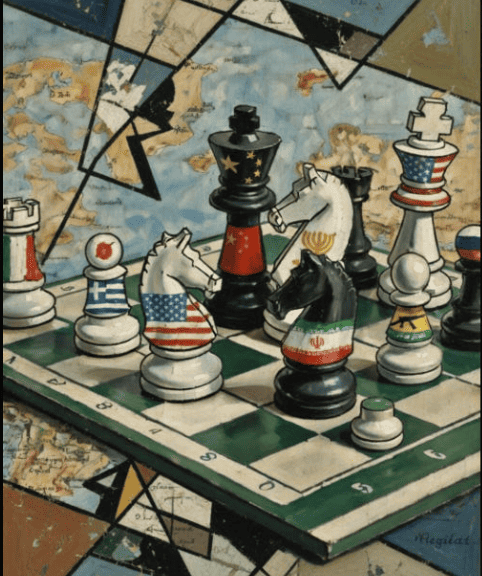
It was 8:15 AM on February 28 when the first bomb detonated in Tehran. Within minutes, Ayatollah Ali Khamenei was dead.
It seemed like another Middle Eastern war was starting, but that interpretation misses the real story. What happened that morning was not simply a military strike; it was America regaining and exercising its realpolitik strategic prowess and making a game-changing move on the world’s geopolitical chessboard.
Picture the board’s state before that attack: on one side, the white pieces were warriors led by the United States and Israel. On the other hand, the black pieces formed an ominous axis made up of China, Russia, Venezuela, Cuba, Latin American narco-cartels, North Korea, a veiled Qatar, and an irate Iran positioned as the axis’s most dangerous attacking piece. In this game, Iran was never the real queen on the board. That role belonged to China. Iran was a knight: an unpredictable piece that leaps past defenses, striking through proxies and asymmetric warfare.
Israel, in contrast, was both a rook and a knight. As a rook, Israel spent years cutting into Iran’s network, striking weapons transfers in Syria, containing Hezbollah in Lebanon, and extending its intelligence reach deep into hostile territory. Yet, when the moment came, Israel acted as a knight, using the element of surprise to clear the board.
By early 2026, having achieved 60% enriched uranium with enough fissile material to possess 11 nuclear bombs within weeks, the Iranian knight had advanced deep enough into the game that the United States and Israel found themselves in a position every chess player recognizes instantly: check.
The Build-Up
To understand the strike on Tehran, one has to step back and look at the entire board. For more than a decade, to ensure access to the requisite energy for its industrial development and economic growth, China had been quietly integrating Iran into its global Belt and Road strategy.
Roughly 80% of Iranian oil exports flowed to Chinese buyers; the revenue of this trade kept Iran’s collapsing economy alive while funding its missile programs, security forces, and terror proxies. Chinese companies also built key pieces of Iran’s digital infrastructure. Surveillance systems, facial-recognition networks, AI monitoring, and censorship tools all allowed Tehran to track dissent and suppress nationwide protests. Militarily, the partnership deepened as Iran acquired advanced Chinese missiles capable of threatening American naval forces in the Persian Gulf. Joint naval exercises between China, Iran, and Russia became routine. Chinese drones and missiles also found their way to Iran’s arsenals, as did China’s cadres of nuclear experts.
On the geopolitical chessboard, this created a dangerous configuration. China, the strategic queen, had placed its knight, Iran, in a position that threatened American power in a multi-pronged attack.
Fanning the Ring of Fire
For decades, Iran had been providing its proxies—Hamas in Gaza, the Houthis in Yemen, and Hezbollah in Lebanon and Syria—with weapons, training, and support as part of its “Axis of Resistance.” This axis was fully activated on October 7, 2023. A month later, the Houthis began attacking maritime lanes in the Red Sea, forcing ships to reroute around the Cape of Good Hope, disrupting global trade. For two and a half years, missile and drone attacks from the IRGC, Hezbollah, and the Houthis intensified, threatening both Israel and U.S. military bases in the region.
Every flare-up forced Washington to deploy carrier groups, missile defenses, and military assets to the Middle East—assets that could not be sent to the Pacific to protect Taiwan and other theaters.
Trump’s Counterattack
Great chess players often begin executing a strategy many turns before the decisive strike. A close look at President Trump’s foreign policy shows that long before confronting Iran, the U.S. had already made major moves in the Western Hemisphere.
Secretary of State Marco Rubio took his first foreign policy trip of the term to Panama, where he succeeded in wresting control of the Panama Canal from Chinese Communist Party-controlled companies. The United States gained dominance over an essential world trade route—and control over the flow of Venezuelan oil to China.
Pressure then mounted throughout 2025 on the Venezuelan regime of Nicolás Maduro, who miscalculated his strength and refused every offer he was given to leave power as a free man. As a result, Maduro found himself unceremoniously deposed and thrown into a cell at the Brooklyn Metropolitan Prison. As a result, Venezuelan oil fell back into the American sphere of influence. That mattered enormously, because any conflict with Iran risked shutting down the Strait of Hormuz, through which over 20% of the world’s oil passes. Securing Venezuelan oil supplies – while far from a full substitute for Persian Gulf volumes – helped ensure that American energy needs and domestic stability would remain more resilient if Middle East flows were subsequently interrupted. At the same time, the move stymied Chinese and Cuban access to discounted Venezuelan oil.
Then came the crackdown on the shadow tanker fleets used by Iran and Russia to evade sanctions. Each of these steps looked isolated at the time, but on the board, they were preparatory moves: forces repositioned, supply lines secured, threats neutralized. Only then did the strike on Tehran occur.
What makes these preparatory moves even more significant is what they quietly erased. For two decades, China had been building its position in the Western Hemisphere with patience and precision, granting more than $120 billion in state loans and $130 billion in infrastructure, while building a trade relationship that tied the region’s economies ever closer to Beijing. That strategy rested on two pillars: Venezuela as the energy anchor, and Cuba as the intelligence platform.
Venezuelan oil flowed east through shadow networks, often settled in yuan, sustaining both Beijing’s growth and Maduro’s regime. Cuba, wired by Huawei and ZTE, controlled intelligence capabilities and assets. Together, they formed the western flank of China’s global design. And then, almost simultaneously, both pillars gave way. Maduro fell. Cuba began to buckle under the loss of subsidized oil and external financing. The intelligence networks went dark, the pipelines stalled, the footholds weakened. Before Tehran was ever struck, the foundation beneath China’s position in the Americas had already been pulled out from under it. On the board, the queen had lost the global influence that made her power possible.
The “Donroe Doctrine”
All of this reflects a broader strategic framework now circulating in Washington: the Donroe Doctrine. A play on the historic Monroe Doctrine, which warned European empires to stay out of the Western Hemisphere, the Donroe Doctrine extended that principle to the modern era: no hostile power, whether it be China, Russia, or Iran, can be allowed to establish strategic footholds in the Americas. Under this framework, removing Maduro from Venezuela was a move to secure the Western Hemisphere’s energy supply and eliminate Chinese, Russian, and Iranian influence close to American shores. In chess terms, it secured its own back rank before attacking the opponent’s position.
The Watershed
Iran’s admission in February to Steve Witkoff and Jared Kushner that it was weeks away from being able to build nuclear weapons was the last straw for President Trump. On February 28, Israel and the United States began their joint assault to save themselves and the world from nuclear disaster.
As of April 13, the IDF has carried out more than 10,800 strikes on over 4,000 targets, including air defense systems, missile launchers, nuclear infrastructure, weapons production sites, and military headquarters. Israeli Air Force operations alone accounted for roughly 8,500 missions over Iranian territory, while U.S. forces conducted an estimated 13,000 strikes on Iranian military targets.
Sixty percent of Iran’s 2,500 ballistic missile launchers have been destroyed. Iran’s air defense network has been substantially degraded, with up to 85% of radar and interception systems out of commission. Sustained strikes on industrial production sites—such as steel factories and oil refineries—have severely disrupted Iran’s ability to manufacture new ballistic missiles, eroding their long-term military-industrial capabilities. In response, the IRGC’s missile and drone attacks against Israel and American assets were also directed at fellow Muslim states in the Gulf, even Iran’s supposed allies like Qatar, neutral countries like Oman, and financial custodians like the UAE, where clerics hid and associates laundered their money.
Flipping the Board
When President Trump ordered the strike that killed the Ayatollah, the immediate objective seemed obvious: stop Iran’s nuclear program and dismantle the terrorist regime. But in chess, the best moves solve more than just an immediate threat: they change the entire position of the board.
Iran’s collapse could send shockwaves far beyond its borders. The shutdown of its oil through the Strait of Hormuz has cut off China’s access to over 1.4 million barrels per day of cheap crude, crippling industrial output and stalling economic growth. With Venezuelan supplies already realigned with Washington, Beijing is facing a severe energy crisis—and the growing threat of domestic political turmoil.
Iran’s proxy forces and its recent attempts at military blockade of the Strait of Hormuz have forced the United States to keep ships and missile defenses in the Middle East instead of the Pacific. If Trump’s counter-blockade of ships going to and from Iranian ports succeeds, it will remove that pressure, and more American military resources will be able to shift toward the Indo-Pacific theater, where the strategic contest for Taiwan lies.
Since April, this change has become increasingly visible, as Iranian proxy coordination has been disrupted and Israel’s continued operations against Hezbollah have further degraded Iran’s ability to sustain multi-front pressure. The Ayatollah’s knight that placed the United States and Israel in check has been removed. Suddenly, the Queen, China, is exposed.
The Endgame
Many critics frame the conflict as just another attempt at regime change in the Middle East. That interpretation assumes the Middle East is the entire board. It isn’t. The real game is the global balance of power in the 21st century.
For Israel, the Iranian capacity for multi-front escalation has been significantly weakened. If this trajectory continues, threats on Israel’s security would be reduced from constant encirclement pressures to a fragmented and increasingly manageable group of threats. In chess terms, the Israeli rook did not end the game in one move, but cleared the lines of aggression that once defined the board. Those lines of attack, long projected outward by Iran, are finally breaking.
The United States was on the defensive until Trump made his move. In a single stroke, the momentum of the game reversed. The Americans and the Israelis are no longer stuck reacting. In contrast, the Mullahs, their fanatical Revolutionary Guards, and their Chinese backers have been placed in check. With every passing day, they move closer to being placed in checkmate.