
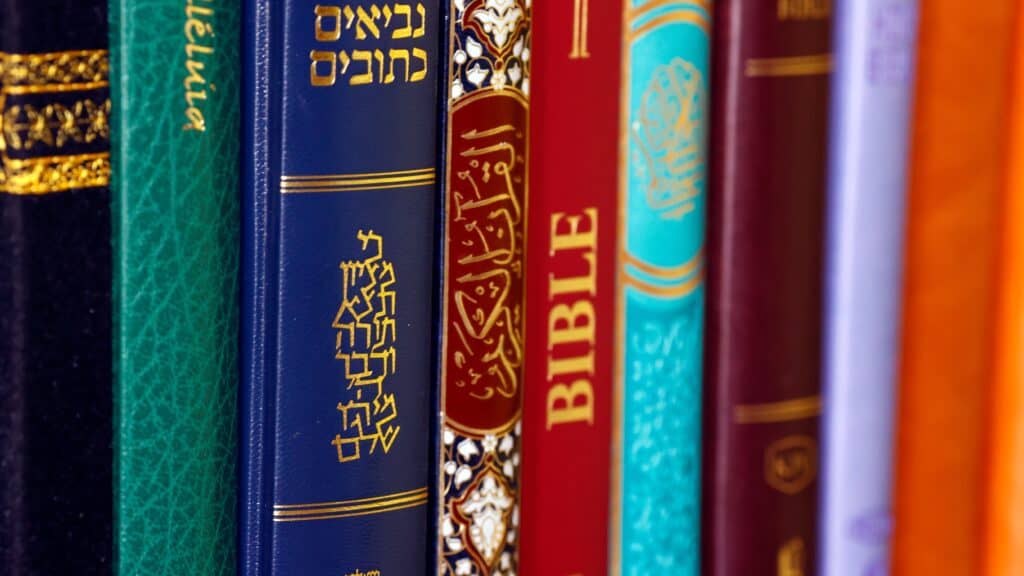
Recent events have not exactly made Jews enthusiastic about interfaith dialogue. If anything, they have made many of us more suspicious of engagement and less interested in being told that our deepest disagreements can be smoothed over by “holding space” for the other side and attending a couple of panel discussions. I understand that instinct, and sometimes it wins the day for me. However, my personal approach to politics has always been to understand opposing narratives as best I can. It can be both refreshing and valuable to hear those with different viewpoints explain themselves when they are not being filtered through my own camp. That principle has taken me to some strange places, from chatting with Russian ultranationalists on Telegram to attending a Zohran Mamdani victory party. Not because I agree, but because I think it is difficult to fully understand and definitively reject a point of view without seeing how its adherents think.
Last year, I noticed that an article calling for interfaith dialogue drew significant backlash from segments within the Jewish community. “Fair enough, given the circumstances,” I thought; we have a right to take a step back in light of everything going on. Still, the article’s challenge to engage lingered with me. That summer, I happened to be discussing Islam with Shlomo, a former NCSY advisor and friend. On a whim, I jokingly suggested a ‘Qur’an Chevrutah’—one thing led to another, and we soon had biweekly midnight study sessions. Part of what made the learning work was that we came to it from different angles: Shlomo was more skeptical and contrarian, while I was more interested in understanding Islam’s internal logic and narrative.
The late hour was due to Shlomo being in Israel and having an all-day yeshiva schedule. Given that the two of us are both Jews, this might not count as true interfaith dialogue, but it still was an honest attempt to engage with Islam and encounter it on its own terms. I have to say that Shlomo and I made a great duo. His years in yeshiva formed a strong Judaic knowledge base and outlook that complemented my more academic, historical, and analytical approach.
We’ve been using Gabriel Said Reynolds’s The Qur’an and the Bible: Text and Commentary, which puts the Qur’an alongside related Jewish and Christian texts. For example, a Mishnaic passage from Masechet Brachot that may help explain when to start Ramadan or an early Christian story about one of the Roman emperors. We chose this edition to provide familiar material in what we expected would be an otherwise foreign landscape, but to our surprise, there was considerable overlap between the Tanakh and the Qur’an. Beyond the large narrative parallels with stories we knew from Bereishit, both books share the idea that anonymous charity is the highest form of giving and that God does not test people beyond their capacity (2:286).
I can’t deny that there were quite a few passages in the Qur’an that I, as a non-Muslim—and especially as a Jew—found problematic. Beyond verses that are horrifying from a humanistic perspective (such as 4:34, which instructs husbands to beat their wives to prevent disobedience), others directly target Jews. For starters, Muslim theology holds that the Tanakh was corrupted over the years (2:75, 4:46, 5:13, 5:41, an idea known as tahrif) and that God sent Muhammad as the final prophet to sort things out (33:40). The Qur’an likewise tells its adherents to kill enemies of Islam (9:5, 9:29, 2:191, 8:39), labeling the Jews in particular as having gone astray, distorted scripture, and shown hostility toward Muslims (5:82 calls them “the most hostile”; see also 2:65, 5:60, 9:30).
We couldn’t simply try to rationalize those verses, nor could we view them as representative of the whole religion. We drew inspiration from how Lord Rabbi Jonathan Sacks addressed violence in religious texts: “If religion is perceived as being part of the problem, then it must also form part of the solution.” Therefore, we treated those verses as what Rabbi Sacks would call “hard texts”—verses that, if taken literally and applied directly, can lead to animosity—which meant reading them as real and troubling, but not as self-explanatory or as the whole religious doctrine.
Since starting the chevrutah, I’ve hoped to find a practical application for what I’ve learned. My opportunity for interfaith dialogue came last December, when I connected on LinkedIn with Mansoor Laghari, a Pakistan-born U.S. Army veteran and anti-extremism advocate whose work focuses on Jewish-Muslim relations. We had constructive conversations over text and Zoom about religion and politics. What stood out about Mansoor was that he was trying to build something more serious than the usual vague talk of coexistence, based on the recognition of religious differences and the need to move forward for the common good.
Mansoor invited me to join his organization, the Global Youth Unity Project, as a founding member. GYUP is still in its earliest stages, but its basic premise was compelling because it attempted to answer what I saw as the central questions in interfaith dialogue: how do you build relationships without brushing aside religious differences as secondary or minor, and how do you fight extremism without reducing everything to a PR battle? GYUP’s mission is to bring youth of all religions together through dialogue, education, and collaborative projects, while countering religious hate, especially antisemitism, and radicalization. What interested me beyond the youth-centered approach was that this was one of the first groups I had found where interfaith work was discussed not as a feel-good volunteering activity, but as something with real moral and political stakes.
For me, that was where the Qur’an chevrutah took on practical significance. Up to that point, the project had been two Jews reading Islam’s foundational text late at night and trying to understand it without sanitizing it. In GYUP, I found myself in conversation with Muslims, Christians, Hindus, and Jews, trying to build something across religious lines. The value of the learning was not that it fully sorted out the tough parts of Islamic theology or that it turned me into an interfaith idealist. It was what made the conversations more serious. I was no longer approaching Islam as a headline, a stereotype, or a political issue. I had already spent months reading its text closely enough to recognize both the overlap and the hard edges, and that made actual dialogue feel less abstract and more honest.