
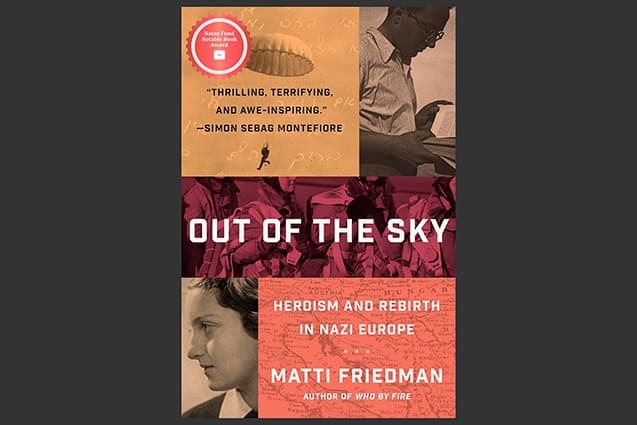
Ever since I first heard the name Hannah Senesh in a seventh-grade Hebrew class, I’ve been fascinated by her story. At the time, it wasn’t her poetry that captivated me, but the way she exemplified commitment to the Jewish people. Armed with the Hebrew she taught herself from a Bible she bought in Hungary, she moved to Mandatory Palestine before World War II to lay the groundwork for a new state. Once the war began, she returned to Europe as a paratrooper in the hopes of aiding the Jews of her home country. Ultimately, though, she was captured and killed by the Nazis and their Hungarian collaborators. Her independence and fortitude drew me to her story, and when I began teaching myself Hebrew, I used her poems as a resource. When I saw that Matti Friedman had published Out of the Sky: Heroism and Rebirth in Nazi Europe, to document the stories of the paratrooper group to which Senesh belonged, I eagerly picked up a copy, hoping to learn more about these volunteers.
To begin, it is essential to acknowledge that Friedman’s work is not a mere history. He begins by declaring that his goal is to write a “true account of my journey into [the parachutists’] story,” to understand why their legacy continues to captivate thousands. Ultimately, Friedman argues that, despite their minimal tactical success or military victories, the paratroopers’ achievement lies in the power of their example. They showed a nation long removed from history how to rejoin it, proving that individuals could once again be active participants in the Jewish story.
Starting with Haim Hermesh, whose memoir Operation Amsterdam is a foundational source, Friedman follows four of the thirty-two paratroopers who jumped into Europe, interspersed with his own journey through the continent in the present day. Although historical records are sometimes sparse, Friedman uses his travels as material for his own reflections, elevating the book and giving meaning to the historical narrative. These reflections are rarely ponderous; rather than interrupt the narrative, they supplement it, challenging the reader to move beyond the myth they already know. Friedman’s use of the present tense for the historical narrative while writing about his reflections and the myths derived from the paratroopers’ story in the past tense is brilliant. Aside from making the reader feel closer to events nearly a century old, the use of the present tense capitalizes on our ongoing fascination with the story overall.
Throughout the book, Friedman seeks to find what motivated these volunteers to risk their lives in Nazi-occupied Europe when they knew they would likely make little impact. To many of us, their decision seems absurd. This question is amplified by the distance (both temporal and circumstantial) between the modern reader and the paratroopers. Friedman’s guidance through the remnants left by these heroes serves as a bridge, allowing the reader to feel closer to these legendary figures. Some of the most memorable scenes occur when Friedman shows us the soldiers attempting to answer this very question. Repeatedly, though they came to recognize the futility of their task, they rarely grappled with their choices in the writings they left behind. As our guide, Friedman tries to fill that gap, using scraps of diaries, poems, and interviews to color the internal motivations of these soldiers.
One of these soldiers, Enzo Sereni, renounces pacifism in his diaries. Friedman uses these entries to shed light on Sereni’s decision.
“Is it always true, he now wonders … that ‘the call for such sacrifice is always a deception foisted by people with dark motives on naive idealists in order to use them as tools in the hands of evil and corrupt forces?’ No, he [Sereni] sees now. There are causes worth dying for.”
Friedman then pairs this quote from a diary with descriptions of Sereni from those who knew him to argue that he was motivated to do so because he was an “apostle”:
“The story he wants to tell is enacted, not written. This quality brings to mind another great Italian, Francis of Assisi: ‘You must preach the Gospel at all times, and when necessary use words.'”
This is classic Friedman, relying heavily on historical sources, while using his own interjections to hammer his portraits home and contribute to characters that are just as much our own creations as they are historical figures.
Thus, Friedman continues by exploring his other three “characters”—Haim Hermesh, Haviva Reik, and Hannah Senesh. He shows how their mission wasn’t just about military objectives, but crafting a story for the future. They hoped that later generations of Jewish youth would have a narrative to look back on to strengthen them as they “look out into the night” (a night that could feel overwhelming and never-ending in the Jewish experience) and push them to “grip the sides of the door and jump.”
As I read this, I found that the ability to identify with these figures living the most extraordinary of lives was the most meaningful aspect of this book. Although the paratroopers were a diverse group, many were quite young, and reading how they contributed to the Jewish people was particularly poignant for me as I reflect on how I want to combat our own generation’s challenges and grow into an age of Jewish communal responsibility. For this reason, Out of The Sky is an especially valuable read for young readers. It reminds us that Jewish history is marked by extraordinary individuals, and we must ultimately decide how best to carry on their legacy.