
As the United States approaches its 250th anniversary, it’s worth asking a question that doesn’t have an easy answer: has American freedom been good for Jewish people? The quick instinct is to respond emphatically in the affirmative. But dig a little deeper, and one realizes that freedom is more complicated than it looks. Just as freedom can build communities up, it can pull them apart.
America was founded on the idea that people deserve the freedom to speak, worship, assemble, and live without the government telling them how to believe. That idea changed history. But for Jewish Americans specifically, freedom has always been a double-edged sword.
In the 17th century, colonial America on the whole was not tolerant towards most minorities. But not every colony operated that way. Pennsylvania and Rhode Island offered genuine freedoms to people of different faiths. For example,. Rhode Island’s 1663 royal charter explicitly guaranteed that no person would be called into question for differing in matters of religion. This language was indeed radical for its time. Jews responded by planting permanent roots in these exceptional colonies. In 1763, the Jewish community of Newport dedicated Touro Synagogue, the first synagogue built in America. The building, which still stands today, is a testament to what a community can accomplish when it finally feels safe enough to build.
But freedom can come with challenges. Intolerance, as ugly as it is, has historically made the Jewish people stronger in certain ways. There’s a pattern that repeats itself across Jewish history: when Jews face persecution, they don’t fall apart. They pull together.
An early example comes from 1654, when 23 Jewish refugees arrived in New Amsterdam (present day New York City) after being expelled from Brazil. The governor wanted them gone, but instead of leaving quietly, they organized and won the right to remain. That once small community has since grown into the largest—and arguably most dynamic—center of Jewish life in the history of the diaspora.
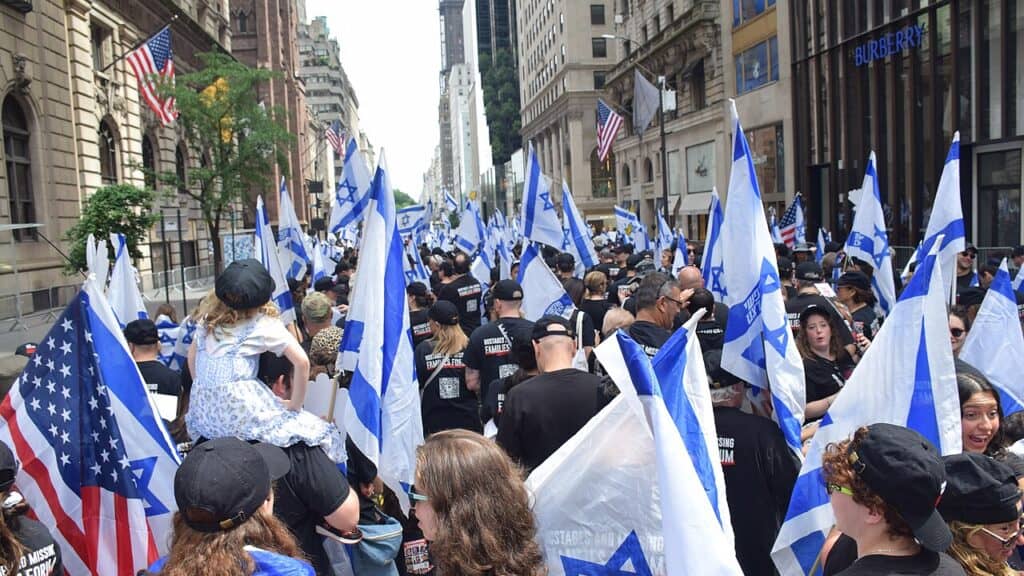
Within days of the Hamas attack, Jewish communities across the United States mobilized at a scale not seen in decades: synagogues became coordination centers; federations raised hundreds of millions of dollars in emergency relief within weeks; and young Jews who had felt only loosely connected to their identity suddenly found themselves buying Israeli flags, attending vigils, and arguing passionately on behalf of a country some had never visited. Crisis, as it has always done, activated a sense of unity and a feeling of mutual responsibility to respond.
But being constantly on defense is not a sustainable way to build a civilization. While pressure creates unity, it also wears on people over time. The noble impulse to confront hatred and injustice from outside the community often allows internal problems to be neglected—and even exacerbated. A community that is always fighting for survival rarely has the strength to grow.
That tension is playing out right now on American college campuses. Jewish students at schools across the country have reported feeling isolated, harassed, and afraid to display visible markers of their identity. Some have removed mezuzot from their dorm room doors. Others have stopped wearing Stars of David or kippot in public. At Columbia University, where the atmosphere has been particularly intense, the campus Hillel reported a significant drop in the number of students willing to attend public Jewish events in the months following October 7. The climate has forced a generation of young Jews into a painful question their grandparents thought had been settled: Is it safe to be visibly Jewish here?
And yet, the response hasn’t only been retreat. At many of those same campuses, Jewish students have also organized with remarkable energy. The discomfort of the moment has, for many, clarified rather than eroded their sense of identity.
This paradox has defined Jewish life in America from the beginning. Freedom creates the conditions for flourishing, but it doesn’t guarantee that Jews will choose to flourish as Jews. For all its horror, antisemitism in a world without freedom never let Jews forget who they were. In a freer world, identity must be sustained by choice—and freedom offers many safer choices than continuing to engage in Jewish life.
That legacy is visible in what American Jews have built today: thousands of synagogues, day schools, cultural institutions, and the philanthropic infrastructure that has helped sustain the State of Israel since its founding. None of it would have existed without the breathing room that freedom provides. All of it required communities—again and again—to choose consciously to build rather than assimilate or fade away.
Today, American Jews are the most integrated Jewish community in history, and for that reason are also among the most at-risk of dissolution through assimilation. Intermarriage rates hover above 70 percent among non-Orthodox Jews. Affiliation with Jewish institutions continues to decline. The threats to Jewish continuity in 2025 are less likely to come from a hostile government than from simple indifference.
Freedom isn’t going to do the work of maintaining Jewish identity for us. It creates the conditions for expansion, but the community still has to choose to build. The lesson of American Jewish history isn’t that we should be grateful for persecution. It’s that freedom is a tool, and like any tool, its value depends entirely on how we use it. As America turns 250, the question for the Jewish community isn’t whether we have freedom. We do, more than Jews have had almost anywhere in history. The question is what we’re going to do with it.