
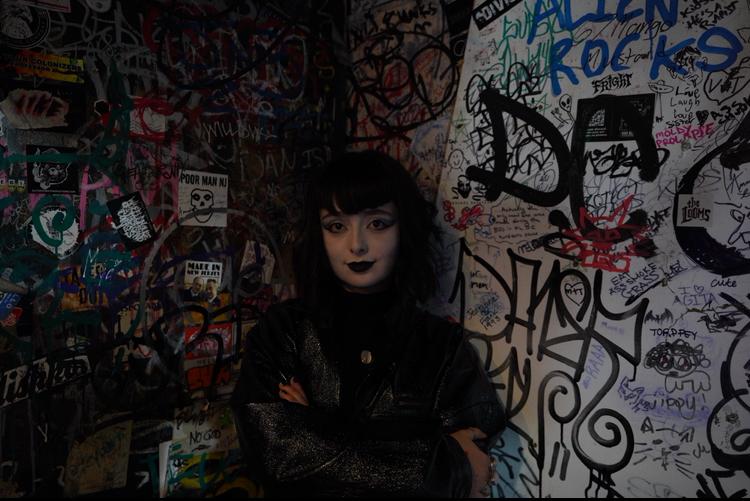
Peering at the stage through cigarette smoke, purple-tinted by the overhead lights, I glimpse a figure stepping forward. Clutching a cloth garment, whose angular geometric patterns I immediately recognize, the figure proudly announces, “This scarf means a lot to me, to us,” and ties the checkered keffiyeh around his neck. Movement ripples through the crowd—heads nodding, the collective exhale by people who, in this moment, feel unimpeachably righteous. Behind him, across the wall, the words, “FREE PALESTINE, END APARTHEID” claw their way out of the chaos: white letters pressed over layers of paint, peeling stickers, and smears of green that had once been posters and graffiti. The words stand out like a flash of neon in the dim haze—not quite a banner, not quite a shout, but something that cannot be ignored.
We are below street level, in a New Jersey basement venue where people gather to sing, dance, and listen to visceral, outspoken music. The walls sweat. The floor shakes. It is, in every physical sense, a place built for the dispossessed. It promised radical inclusivity and liberation for the marginalized. Yet, the feeling rising in my chest is not new. Jews have stood in rooms that did not want them for thousands of years and have walked out the other side carrying something that could never be confiscated: the insistence on remaining, on creating.
Raised on the mournful sway of klezmer and the raw dissonance of Russian post-punk, a culturally alternative Jew by upbringing and instinct, I have always been drawn to the counterculture ethos. Growing up within a predominantly Christian community, I found in the subculture a space for creative expression and freedom. Punk’s defiance of authority, challenge to dominant narratives, and habit of building community at the margins naturally resonated with my life as a Jew in the Diaspora.
The Hebrew idea of chutzpah—audacity before authority—is more than a cultural quirk; it’s a survival instinct honed through centuries under regimes that demanded Jewish silence. The modern world’s artistic rebellion was shaped by that same refusal to bow before power. When the children of postwar Europe and America looked into the void left by the Shoah, they found the same fire—an urge to speak, to shout, to refuse obedience. Early punk’s raw defiance was no accident. Punk was born in the mid-1970s in New York and London—three chords, a scream, and a deliberate rejection of everything polished and powerful. It gave voice to those the mainstream had discarded and turned confrontation into an art form.
Its generation matured in the Shoah’s shadow, inheriting not only unimaginable loss but the collapse of the ideals that were supposed to prevent such an ineffable tragedy. When humanity’s promises failed so completely, nihilism filled the void. Punk gave that grief a pulse. In the aftermath of October 7th, many young Jews feel that old rupture. Once again, the myth of enlightenment fractures, revealing itself not as eternal truth but as performance—sustained only while it serves power.
Punk taught me that silence is always a choice. After October 7th, I encountered a silence that was harder to name, a silence Jews know well, and punks have long recognized—the quiet that follows when a community decides which pain is acceptable and which is inconvenient. It is that dynamic—the conditional welcome, the tolerance with an expiration date—that defines the experience of Jews in countercultural spaces today.
The answer may lie not in abandonment but in reclamation: drawing on our own radical traditions, remaining at the center of these politically complex places, and recognizing that the punk spirit of questioning, creating, and resisting has always been part of our DNA. Reporting this piece pulled me closer to the scene and my Judaism alike, proving that redirection is not retreat—it is renewal. In the conversations I sought out, the shows I attended, and the stories I chose to follow, I found myself not just documenting a community but reckoning with my place in it.
So, what does the punk ethos offer Jews today? I believe it can be a catalyst for innovation, for exploring new ways of existing within those spaces as both a Jew and a punk.
My Judaism has often found its truest expression not in doctrine, but in belonging—in the warmth of a creative, confident, and singular collective that mirrors the counterculture communities that first shaped me. It was in a synagogue that I discovered the comfort of shared spiritual life; it was in a music venue that I was first invited to inhabit myself fully, to speak without words in the way I moved through the world. Both spaces offered the same essential gift: the freedom to exist without apology, to bring your whole, unguarded self into a room and be received.
Rabbi Gavriel Goldfeder, a Jewish studies professor and self-described lifelong rock star sees the two communities as sharing a single, beating heart: allowing young people the “permission to experiment, to wonder, to create, to emerge, and often to rage.” What unites them, in his words, is a quality of “depth, realness, honesty, curiosity, and contact,” that rare, electric aliveness that refuses to be flattened, and that lies at the core of how a person truly becomes themselves.
My identity within these spaces, though sometimes threatened, is not so fragile as to be undone. It is sustained through connection—through finding the kindred spirits who understand that to be fully Jewish and fully punk is not to live in contradiction, but in completion. When Joey Ramone screamed into a microphone and when a yeshiva student pounds the table to prove the Rambam wrong, they are doing the same thing. It is the same deeply Jewish tradition that runs from Talmudic disputation straight through to the great muckraking journalists who believed that no power, no narrative, and no mob consensus is ever too sacred to interrogate. These two parts of me do not compete; they compose. One without the other would leave something essential incomplete. As Rabbi Goldfeder puts it: “Punk [is a] vision—expand! Try new things! Be you!” For someone who has always lived at the intersection of ritual and rebellion, this vision feels like home.