
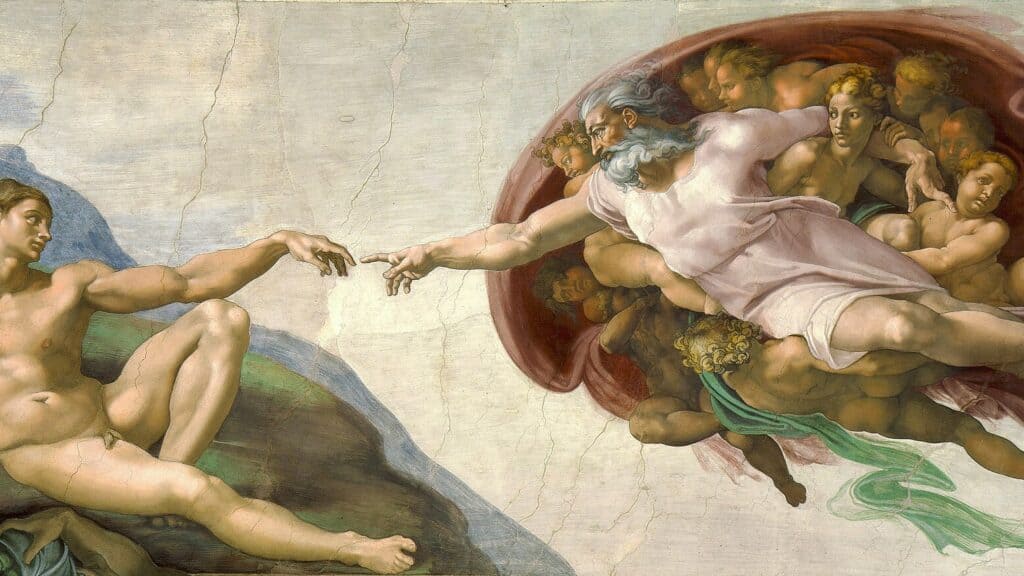
“In the beginning of God’s creation of the heavens and the earth.” (Genesis 1:1)
In 21st-century America, the Genesis narrative is read against competing theories: The Big Bang (which posits a 13.8 billion-year-old universe), and a Darwinian view of humanity (as one contingent branch on an indifferent tree of life). In our modern times, the idea of a purposeful cosmos created in six days is considered outdated, to say the least.
Jews in America have been free to wrestle openly with this tension. Wrestling, after all, is one of our oldest traditions. The very name Yisrael means “one who wrestles with God.” The freedom America has granted Jews is not a threat but a gift.
America’s founding commitment to religious liberty and intellectual freedom created something genuinely new for Jewish intellectual life. For the first time, Jewish thought was protected as a matter of constitutional right. Across the medieval world, from the disputations of 13th-century France and Aragon to the courts of the Abbasid Caliphate and the fragile refuge of Fatimid Cairo, Jewish intellectual life flourished in the gaps that other civilizations permitted. Maimonides fled Almohad persecution as a child; Nachmanides was forced into exile after his superior performance in a debate against a Dominican friar; Saadia Gaon wrote under a tolerance whose limits were never his to set. America was the first civilization to make Jewish intellectual sovereignty a founding principle.
Jonathan Sarna observes that freedom produced an unprecedented religious voluntarism in America, allowing Jews to abandon their faith, values, and communities, often turning to science as a replacement. Science became, for some, a reason to walk away from tradition entirely. This is the challenge that freedom poses.
However, even without knowledge of modern science, the Jewish tradition has long sought to reconcile reason and revelation. Saadia Gaon, writing in tenth-century Babylonia, argued that reason and revelation cannot ultimately contradict one another, since both derive from God. Any apparent conflict, he wrote, stems from human limitation and calls for renewed scrutiny of both reason and revelation to restore their harmony.
Maimonides builds directly on this foundation. In The Guide for the Perplexed, he argues that scripture must be reread non-literally wherever reason and science establish that the literal meaning is impossible. References to God having a body and emotions are simply the Torah using language comprehensible to human beings (dibra Torah k’lashon b’nei adam). In these instances, therefore, we must adopt a non-literal mode of interpretation.
Maimonides, like Saadia before him, believed that when scientific knowledge establishes that a literal reading is flawed, it is incumbent upon religious individuals to reinterpret texts. Being faithful to the Torah means reinterpreting, not resisting. To read the “six days” literally in the face of overwhelming scientific evidence is therefore not an act of faithfulness. By Maimonides’ own standard, it is a failure of both reason and Torah.
According to the Big Bang Theory, all matter, energy, space, and time were emitted from a point of infinite density. Within seconds, protons and neutrons formed, leading to the first appearance of light. Science describes this progression towards life with precision, but hits a wall when it comes to explaining what precedes that moment. All the same equations that explain universal expansion after the Big Bang fail.
The Torah begins exactly at the point where science fails and where physics breaks down. Its opening word (“In the beginning…”) is an invitation to dwell on what it means that the furthest reach of physical description and the first word of revelation address the same mysteries of the universe.
Nachmanides argues that God first created a single formless substance, which contained the potential for all future forms. He was not working in a physics laboratory, but the parallel with the Big Bang is noteworthy. The Psalmist writes, “The heavens declare the glory of God, and the sky above proclaims His handiwork” (Tehillim 19:2). For the modern Jewish reader, the James Webb Space Telescope is an instrument for hearing that declaration with a clarity no previous generation could have imagined.
The Torah and science are sometimes treated as contradictory, but should rather be seen as two sides of the same coin. Each seeks truth and a deeper understanding of the human condition. Science, with its endless expansion of what we do not yet know, should be seen as faith’s companion instead of its rival.
As America turns 250, Jews have been fortunate to enjoy the freedom not merely to ask any questions, but to follow answers wherever they may lead. Judaism can sit at the table with astrophysics, geoscience, and biology, not despite its tradition but because of it. Science allows us to probe our tradition by compelling us to ask new questions, engage with novel evidence, and see Torah in a new light.